
When people search “Haitian music genres,” they usually expect a quick list. Five bullet points. Maybe a Spotify playlist recommendation. Something they can skim while the song they heard at a party is still stuck in their head.
What they are not prepared for is a centuries-deep archive of sound, music that survived the Middle Passage, outlasted colonial empires, birthed entire genres across the Caribbean and beyond, and still shows up every week in living rooms from Port-au-Prince to Pétion-Ville to Flatbush.
Haiti does not just have music. Haiti is music. And to understand the genres is to understand the people.
Before the Genres: Where It All Comes From
You cannot talk about Haitian music without talking about what built it.
Haitian music is rooted in African musical traditions brought over through the forced migration of slavery. At its foundation is the spiritual music of Vodou — heavy drumming, spiritual dancing, and chanting, which became the foundation for everything that has radiated from Haiti since.
Over centuries, that foundation met French colonial culture, Spanish influences from the shared island of Hispaniola, Taino echoes from the original inhabitants of the land, and eventually American jazz, Cuban rhythms, and global pop. The result is a musical tradition with hints of French, African rhythms, Spanish elements, and minor native Taino influences, but shaped into styles of music unique to Haiti that exist nowhere else on earth.
What makes Haitian music remarkable is not that it absorbed these influences, every culture does that. What makes it remarkable is what it did with them. Every genre below is proof that Haitians did not just receive culture. They transformed it into something entirely their own.
Konpa was born in Port-au-Prince in 1955. It helped shape the music of Martinique, Guadeloupe, Cape Verde, Portugal, and West Africa. The world danced to it — and didn’t always know where it came from.
Vodou Music, The Root of Everything
Before there was a genre, there was ceremony.
Vodou music holds a sacred place in Haitian culture, closely tied to the Vodou religion, which blends African spiritual practices with other traditions. The global interest in Vodou music has led to an appreciation of its cultural significance, with more people seeking to understand the complexities of Haitian spirituality through its musical expressions.
Vodou music is not entertainment. It is communication, between the living and the lwa (the spirits), between communities and their ancestors, between the present moment and everything that came before it. The tanbou (drum) is at the center of it. The ogan (iron bell) keeps the heartbeat. The voices form a chorus that reaches backward in time thousands of years.
To skip past Vodou music on the way to “the popular stuff” is to skip past the engine that powers everything else on this list. Every Haitian genre — whether it admits it or not, is downstream from this.
Méringue, Haiti’s First National Sound
Before Konpa was born, there was Méringue. And here is something the internet almost always gets wrong.
Do not confuse Haitian méringue with the Dominican merengue. The difference is significant, merengue uses the accordion as its base instrument, while Haitian méringue is built on the guitar. Two countries. One shared island. Very different sounds. They are cousins, not twins.
Méringue has deep roots in Haiti stretching back to the 19th century, it was the soundtrack of ballrooms, of the Haitian elite, of state ceremonies. Its elegant, string-driven style became the musical vocabulary of a newly independent nation that was trying to define itself on its own terms. And when Nemours Jean-Baptiste came along in the 1950s and modernized it, he did not erase Méringue. He used it as the clay.
Konpa, The National Rhythm
If you have ever been to a Haitian party, a wedding, a birthday, a fèt of any kind, you already know what Konpa sounds like. You may not have known its name, but your body remembered it.
Konpa emerged in Haiti during the mid-20th century, a time of significant cultural and political change. The genre was created and popularized by Nemours Jean-Baptiste, who founded Ensemble Aux Callebasses in 1955. The traditional Konpa sound features the brass instruments of big band, saxophone, trumpet, trombone, and the slower rhythms of méringue de salon, set to the pulsating beats of the tanbou, a barrel drum from Haiti.
The name itself comes from the Spanish word compás, meaning rhythm or measure. But the sound is entirely Haitian.
As Konpa gained popularity in Haiti, it began to spread internationally, especially during the 1960s and 1970s. Haitian immigrants carried the genre to places like the United States, Canada, France, and the Dominican Republic, where it influenced and blended with other styles of music. Konpa played a significant role in shaping zouk music in the French Antilles, as well as influencing Dominican merengue.
Think about that for a moment. A genre born in Port-au-Prince in 1955 traveled across the Caribbean, crossed the Atlantic, and helped shape the music of Martinique, Guadeloupe, Cape Verde, Portugal, and West Africa. Haitian musicians did not just keep their sound, they exported it, and the world danced to it without always knowing where it came from.
In March 2024, Haiti submitted Konpa to be included on UNESCO’s List of the Intangible Cultural Heritage of Humanity. It was long overdue.
Mini-Jazz, When Haiti Went Electric
As Konpa spread throughout the Caribbean, jazz groups adopted a stripped-down lineup format called mini-jazz, which reduced the brass component while increasing guitars. What started as a practical adjustment, smaller bands, more intimate venues, the electric guitar replacing the horn section, became its own movement.
Mini-jazz was derived from Haitian Konpa during the 1960s. Haitian rock bands experimented with using two guitars, a drum-conga-cowbell, and one bass with an alto saxophone. You would often hear these bands playing in neighborhoods throughout the capital city of Port-au-Prince. The Konpa band Shleu-Shleu is credited for starting the Mini-Jazz trend in the 1960s.
Mini-Jazz produced some of Haiti’s most beloved bands, including Tabou Combo, who eventually took the sound global and became one of the best-known Haitian musical exports in the world. If Konpa is the formal suit, Mini-Jazz is the open collar. Same family. Different energy.
Rara, Music That Moves Through the Streets
Rara is performed between Ash Wednesday and Easter Sunday, the day after Carnival ends until the resurrection. Rara bands roam the streets performing religious ceremonies as part of their ritual obligations to the lwa.
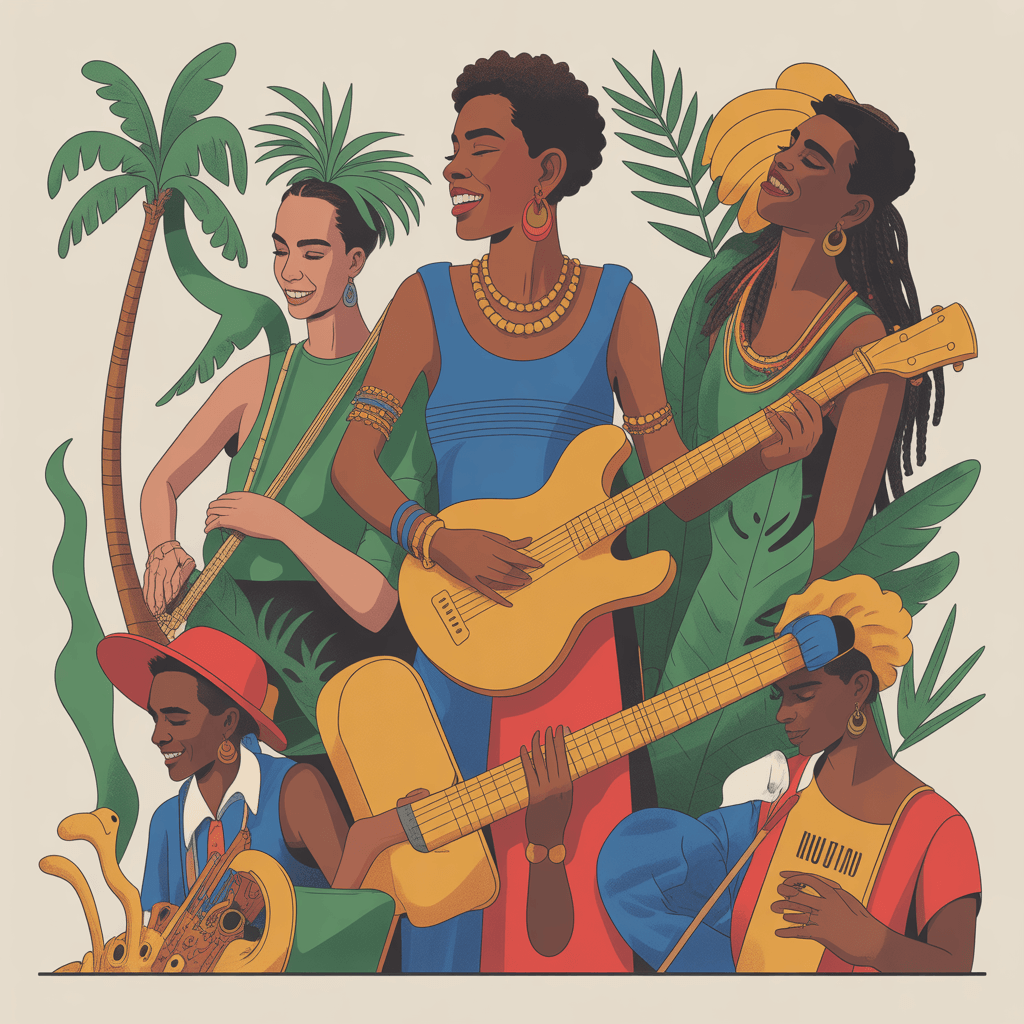
Rara is not a concert. It is a procession. It moves. The band walks, and the community follows, or gets swept up, through neighborhoods, along roads, into fields. Musicians play maracas, bells, and trumpets made of bamboo or metal pipes called vaksen. Modern Rara musicians also play saxophones and march in parades with baton twirlers, dancers, and other performers.
The lyrics of Rara songs often convey messages related to social and political issues, reflecting the struggles and aspirations of the Haitian people. The genre serves as a form of social commentary, allowing musicians to address injustices and express their hopes for a better future.
This is music as community act. As spiritual practice. As political speech. In Haiti, the line between those three things has never been as clean as the outside world might like to believe.
Mizik Rasin, The Roots Movement
In the 1990s, commercial success came to the musical genre that came to be known as mizik rasin, or roots music. Musicians like Boukman Eksperyans and Boukan Ginen incorporated reggae, rock, and funk rhythms into traditional forms and instrumentation, including Rara, Carnival music, and traditional spiritual music from rural communities called lakous.
Mizik Rasin was also a political statement. It emerged during the Duvalier dictatorship years and the protests that followed, when a generation of Haitian youth refused to let their culture be flattened by authoritarianism or American commercial music. The politically-minded group Boukman Eksperyans, which rose to fame during protests against the coup that removed Jean-Claude Duvalier in the 1990s, became Grammy-nominated and remains one of the defining voices of this movement.
The name says everything: Rasin — roots. When a culture is under pressure, it goes back to the ground. It remembers where it comes from. That is what Mizik Rasin did.
Twoubadou, The Troubadour Tradition
Twoubadou is a form of music played by peripatetic troubadours performing some combination of acoustic guitar, beatbox, and accordion — singing ballads of Haitian, French, or Caribbean origin.
Haitian Twoubadou was developed in the early 20th century as a combination of méringue and Cuban guajiro. The performer usually plays guitar while singing about love — lyrics that are suggestive, with a combination of humor and bitterness woven together.
Twoubadou is perhaps the most intimate of all Haitian genres. It is the genre of poets, of street philosophers, of the man sitting on the gallery at dusk with a guitar and something to say. Artists like Coupé Cloué made it into an art form unto itself — equal parts song, commentary, and comedy. Twoubadou does not perform for the audience. It sits down next to you.
Rap Kreyòl, Haiti’s Generation Now
Rap Kreyòl is hip-hop music performed mostly in Haitian Creole. Emerging in the 1980s, the genre, like American hip-hop, addresses societal issues, political struggles, and everyday life in Haiti. Rap Kreyòl is popular with Haiti’s youth, allowing them to share their perspectives with a global audience.
And it has never been more powerful than right now. A generation of Haitian artists — in Haiti, in the diaspora, online — are using Rap Kreyòl to say things that the news cycle ignores, to document realities that international media distorts, and to assert a Haitian identity that does not apologize for its complexity. Artists like BélO, Izolan, and others have shown that Haitian Creole is not a barrier to global reach — it is the whole point. The language is the flag.
What Most Articles Leave Out
Here is what the Wikipedia summaries and music blogs tend to skip: Haitian music genres are not just categories. They are different relationships between a people and their world.
Vodou music is a relationship with the ancestors. Rara is a relationship with the community. Konpa is a relationship with joy — with kè kontan, the happy heart, even in the hardest circumstances. Mizik Rasin is a relationship with resistance. Twoubadou is a relationship with truth told sideways, through a smile and a guitar.
This is why, when Haitians hear music, they do not just nod along. They lean in. They recognize something. The music is always saying something that words in any language, French, English, Spanish, could not quite reach.
Anyone who sings in French during a Haitian holiday would likely get scolded, because these celebrations are supposed to be about honoring African ancestry. French is a reminder of colonialism — and Haitians do not want to honor that. The choice of language in music is never casual in Haiti. It is always political. It is always personal.
The Haitian Take
There is a reason Haitian music has traveled so far, from Port-au-Prince to Paris, from Pétion-Ville to Montreal, from Jacmel to the stages of Carnegie Hall. It is not just that the rhythms are infectious, though they are. It is not just that the melodies are gorgeous, though they are.
It is that Haitian music carries history in the body. When you dance Konpa, you are moving to a rhythm that survived everything this island survived. When a Rara band comes down your street, you are standing inside a ritual that predates Haiti’s independence. When a twoubadou sings his bittersweet love song, you are hearing a man tell the truth about what it means to be human under an unforgiving sun.
The Haitian proverb says: “Men anpil, chay pa lou” — “Many hands make the load lighter.” Haitian music has always been those many hands. Genre after genre, generation after generation, artist after artist — lifting the same weight, together, with style.
That is the sound of Haiti. And it is unlike anything else in the world.